Monday, September 15, 2014

Southeast Alaska Recap Part 2!!

Monday, September 15th, 2014 - Olympia, Washington

Now that I have returned from Europe (Portugal and London were amazing and will be featured in a future blog post), I can continue my posts about Southeast Alaska!

We left off at Petersburg, which would be followed by the exploration of Frederick Sound and Chatham Strait.  Each week, we would arrive at Pavlof Harbor, which carries the waters of Pavlof Lake out into Freshwater Bay.  After taking a zodiac to shore, one would arrive at the mouth of the Pavlof River.


This intertidal zone, with assistance from the fish ladder (the step-like structure on the right), serves as a salmon buffet for the predators in the area, especially the brown bears.


Despite this knowledge, we proceeded along the water's edge.  At one point, our naturalist guide, Rich, felt that we were being watched.  Looking to the ridge on the right, we spotted this little fella'...


...who happened to be drooling and popping his jaw.  These were signs to us that we were an obstacle between him and his next meal.  We had two options: let him proceed to his meal...or BECOME his meal.  Needless to say, we retreated and watched from a safe distance.

Bears have a hierarchy of sorts.  This being a smaller bear, it would venture down to the water, catch a fish and retreat to the safety of the woods, ensuring that it would not be harassed by a larger, hungrier bear.


It returned two more times; this bear could eat!


The next day would find us in the Inian Islands, a fantastic place to view wildlife!

Bald eagles...


...Stellar's sea lions...


...and bald eagles stealing fish from Stellar's sea lions.
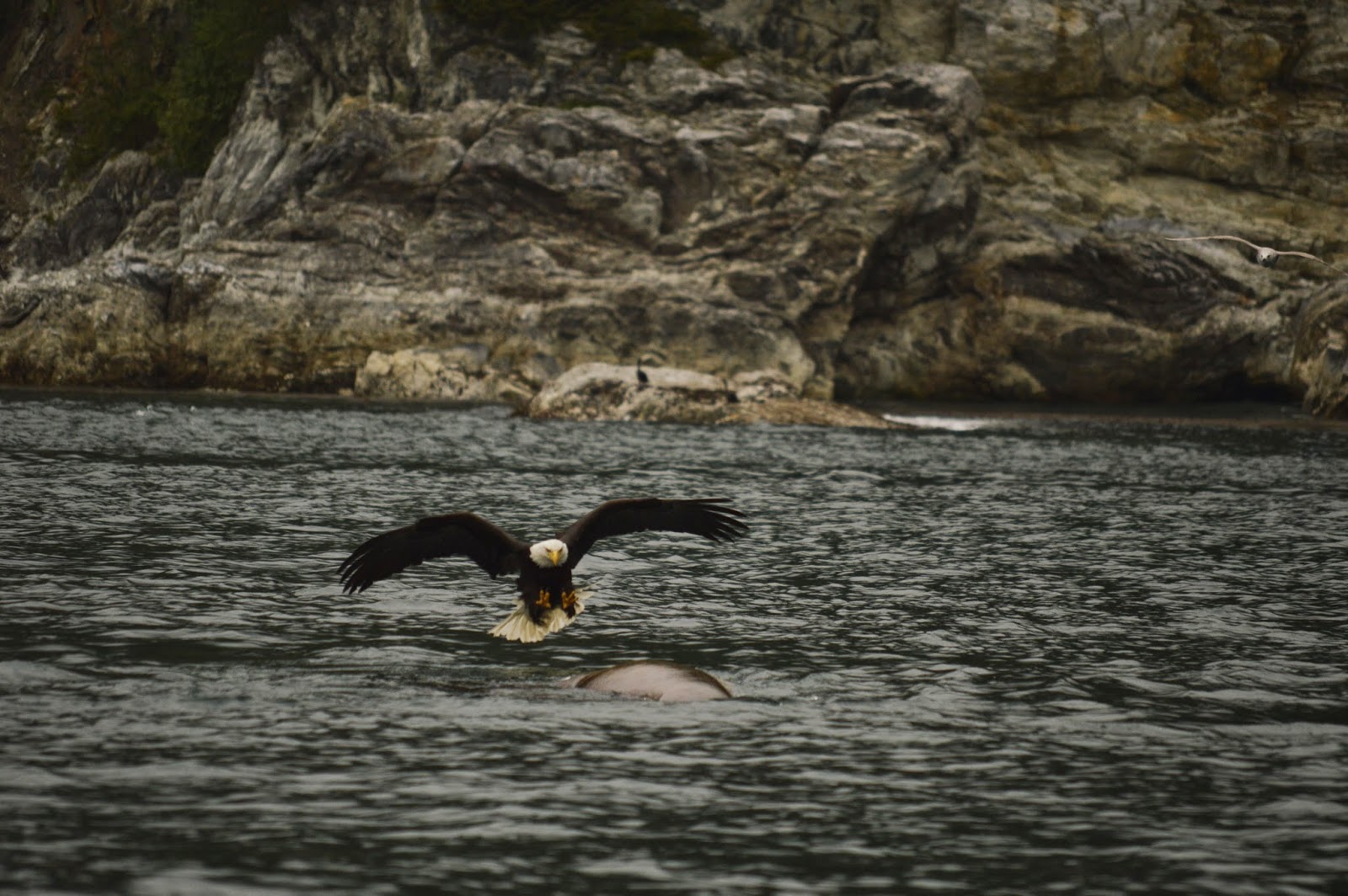


I could not stop talking pictures of these crazy creatures.


The second half of the day would be spent at Fox Creek and Shaw Island.  Upon reaching the beach, one can embark on an incredible hike up to a muskeg...

Photograph Courtesy of Rachel Eaton

Photograph Courtesy of Rachel Eaton

...and pick wild berries, including blueberries and mini-strawberries (which were ridiculously sweet).


That shall end this post.  On the next one, we shall finish Southeast Alaska!!

Monday, August 25, 2014

Southeast Alaska Recap!!

Monday, August 25th, 2014 - Olympia, Washington

I realize that it has been a lifetime since I last posted;  I sincerely apologize to those waiting with bated breath.

To start, Southeast Alaska (and the remainder of the state, I am assuming) is incredible!!  It is teeming with vivid vistas, wary wildlife and friendly folks who live the lionhearted lifestyle.  Too much alliteration?

In order to give this post some structure, I will run through one of my weeks during Lindblad's "Exploring Southeast Alaska" season.  Let's begin with Juneau...


...and a bald eagle sitting, dead-center, in front of our bow.  I have truly been spoiled, as seeing bald eagles has become a regular occurrence while working here.  Truly magnificent creatures!!

After loading guests on-board and hitting the town until about midnight, we usually set sail, heading for Tracy Arm - Ford's Terror Wilderness.  This is a truly awe-inspiring area, complete with rock faces that tower over you...


...and wonderful hillside waterfalls,...


Little ol' Dave the Deckhand acting as a model for scale.


...some of which you could trace back to the source.


One could also encounter the occasional, slightly whale-shaped iceberg on one's way back to the ship.


Usually, our next stop would be Cascade Creek, followed by Petersburg (my personal favorite; it has a really nice, "small town" feel).  I was lucky enough to partake in flight-seeing there, flying over LeConte Glacier and its surroundings.


The pilot informed us that this glacier is the fastest-moving one in the world, reaching about 90 feet per day.


From above, the harbor seals looked like little sausages on ice.


After taking in the majesty of the wilderness, we made our return to Petersburg, and that is where I will leave off for this post.  On the next one, I will continue through the itinerary.  For now, enjoy the view of a sunset from the ship.

Photograph Courtesy of Ben Miller

Saturday, May 31, 2014

Haida Gwaii!!

Saturday, May 31st, 2014 - Off the coast of Chichagof Island, Alaska

We are in the middle of our third northern expedition.  The first trip lasted two weeks, bringing us from Seattle to Southeast Alaska.  Along the way, we made a few stops in British Columbia, one of which was in Haida Gwaii (formerly known as the Queen Charlotte Islands).

Haida Gwaii is an archipelago that has been populated by the Haida Nation for more than 12,500 years. Some of the islands are protected by the federal government, which has deemed it the Gwaii Haanas National Park Reserve and Haida Heritage Site.  It is a sincere privilege to be invited upon this land.

We were able to visit Anthony Island, one of the southernmost islands of the archipelago.  Upon this island is the site of SGang Gwaay Llnaagay, which was once a major village for the Kunghit Haida.  A replica of one of tribe's four-post houses greets you at the beginning of the trail.


 Continuing up the trail, you arrive at one of the house pits, upon which sat one of those four-post houses.


The Haida would move around depending on the season, requiring them to have a system of relocating.  The houses were assembled with pieces that were easily deconstructed and transported (via canoe) to the next settlement.

The chief of this particular village had a six-post house, where many celebrations and meetings took place.  The pit for this house was left with the main posts relatively in place.


During our trek, we arrived at a little inlet created by a large rock formation known as "fortress rock."


It received this name due to the fact that, if attacked, the women and children would climb up ladders placed against the rock.  The vertical rock face made it difficult for attacking tribes to reach the top; the rocks being thrown by the protected women and children did not make it any easier either.

On the beach of this little inlet, you encounter mortuary poles.


These were the graves of high status people.  The pole was carved with the crest of the deceased person, which usually told the story of the person, their family and their status within the tribe.  The remains of the deceased, placed in a bentwood box, were housed in the hollow top of the pole.

The poles that we encountered were in various conditions.  Some had decayed, while others had been burned by attacking clans.


I may have an additional Haida post coming soon, just to fill in any information that I can about these people and their fascinating culture.  For now, I will continue doing my research.